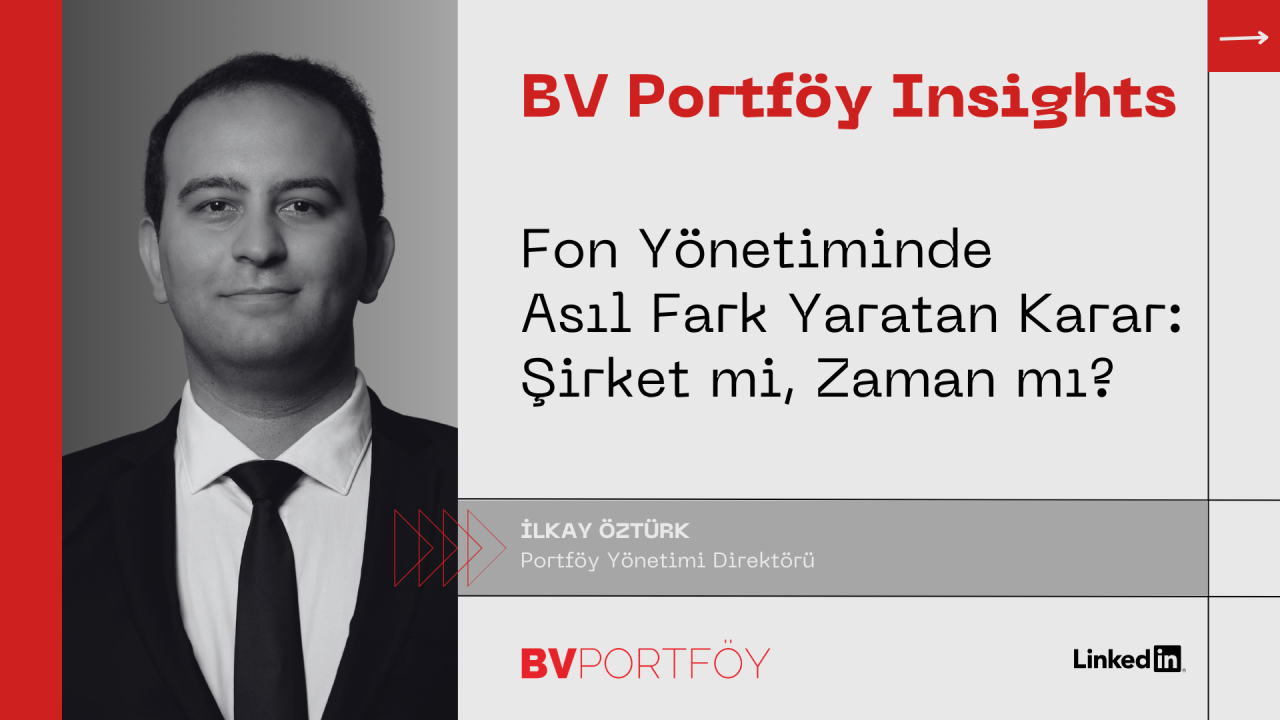
The Decision That Truly Makes the Difference in Fund Management: Company or Timing?
The question that occupies investors' minds most in financial markets is this: Does success come from picking the right company, or from being in the market at the right time? This question is often framed as two competing approaches
The question that occupies investors' minds most in financial markets is this: Does success come from picking the right company, or from being in the market at the right time? This question is often framed as two competing approaches. Yet in the real world, sustainable returns do not stem from a single decision — they emerge from a layered, professionally managed mechanism in which multiple factors interact.
At the heart of this mechanism lie two distinct concepts of "time." The first is the investment time horizon. Long-term data shows that wealth creation depends largely on the ability to stay invested in the right companies over extended periods. The power of compounding reveals itself not through attempts to predict the market, but through the patience to remain in it. For individual investors, however, maintaining that patience amid market noise is extraordinarily difficult. This is precisely where a fund manager adds value — by delivering a disciplined, emotion-free roadmap on behalf of the investor, realizing the full power of time.
The second concept is timing — that is, entry point management. Many investors remain on the sidelines "waiting for the right moment" and miss the most significant opportunities as a result. Professional fund management, however, treats timing not as a claim of market prediction, but as a discipline of risk management. Fund managers use quantitative analyses across large datasets to optimize entry and exit points through rational models rather than emotional reactions.
While the power of time is undeniable, not every instrument in the market can be expected to generate value over time. On the contrary, the vast majority of market returns come from a very small group of "winners." This is where active fund management makes its most critical contribution: company selection. Professional research teams identify companies capable of generating "alpha" by detecting the gap between price and intrinsic value. In other words, while professional timing strategies contain downside risk within the portfolio, it is the right company selection that drives the portfolio's long-term growth.
Within this framework, a professional fund management process is shaped around three core layers:
- Company Selection: Identifying business models with high competitive advantages that will create long-term value.
- Time Horizon: Managing the patience and strategic discipline required to allow that value to materialize.
- Entry Point: Gaining exposure at the most appropriate levels while minimizing risk.
If any one of these layers is missing, the investment process breaks down. A great company purchased at the wrong price may deliver limited returns; a weak company entered at the right price will not create lasting value. And even with the right company and the right entry point, an individual investor's impatience can destroy the entire potential.
In conclusion, the question "right timing or right company?" is incomplete on its own. What truly makes the difference is selecting the right company, entering that position at the appropriate level with professional risk management, and — most importantly — having the discipline to hold that position long enough. In the world of investing, success is not born of chance decisions, but of this holistic strategy executed with a professional management philosophy.
Discover Trending Funds



Apply now to start
smart investing
We will get in touch with you ASAP!
We've received your request, and our team will be in touch with you shortly. Please stay tuned, and thank you!